
Poodle Temperament is one of those topics people think they understand, until they live with one. They’re often described as smart, elegant, and easy to train, which is true, but it’s not the full picture. Poodles are intense little detectives. They notice patterns fast, they read your mood, and they can accidentally train you just as quickly as you train them.
If you’re considering a Toy, Miniature, or Standard Poodle (or you already have one), this guide will help you predict the personality you’re likely to get, understand the quirks that surprise new owners, and shape behavior before it turns into a “problem.”
KEY TAKEAWAYS
- Poodles are typically bright, people-focused, and sensitive, which makes training easy and emotions louder.
- Toy, Miniature, and Standard Poodles share core traits, but size changes arousal, confidence, and noise tolerance in real life.
- “High energy” is often a mix of athletic needs and mental restlessness, not just a need to run.
- Clinginess can be affection, habit, or anxiety, the fix depends on which one it is.
- Barking usually improves fastest when you identify the trigger type (alert, demand, separation), then train a replacement.
- “Aggression” concerns are often fear, guarding, or overhandling, and management matters as much as training.
Poodle temperament, in plain English
Temperament vs training vs “that one weird habit”
Temperament is the default setting your dog tends to return to. Training is the software update. And habits are the shortcuts your poodle learns because they work.
That distinction matters, because people sometimes label a poodle as “naughty” when the dog is simply over-aroused, under-stimulated, or accidentally rewarded for something annoying (like barking to start play).
The Poodle’s core personality traits (the good and the challenging)
If I had to sum up poodle personality traits in one line: they’re socially plugged-in and mentally switched on.
That shows up as:
- Fast learning and strong pattern recognition (great for cues, also great for learning how to open the bin).
- A big preference for being near their person, even when they’re not actively cuddling.
- Sensitivity to tone, handling, and household stress, which can look like “dramatic” behavior.
- A tendency toward alertness, which is helpful, until it turns into poodles and barking at everything with a pulse.
Toy vs Miniature vs Standard: what changes, what doesn’t
All three sizes can be affectionate, clever, and eager to engage. The differences you notice day-to-day are often about arousal and environment. A tiny dog in a noisy flat has a different experience of the world than a bigger dog with a garden, even if they share the same breed label.
Toy Poodle temperament (tiny body, loud opinions sometimes)
Toy Poodles are often described as bold, attached, and quick. In practice, their biggest challenge is that the world is physically overwhelming. Doors slam, people loom, hands swoop in, and they get carried a lot.
That combo can create:
- More startle responses.
- More “I’ll tell you about it” barking.
- More snap-and-retreat behavior if handling feels unpredictable.
It doesn’t mean Toy Poodles are aggressive dogs. It means they benefit massively from choice-based handling and calm exposure to everyday stuff.
Miniature (medium poodle temperament in real life)
Miniature Poodles often hit a sweet spot: portable, athletic, and less fragile than Toys. They can still be vocal and vigilant, but many owners find they’re easier to socialize confidently because you can do more with them without constantly managing physical risk.
If someone asks me “Do mini poodles bark a lot?”, my honest answer is: they can. But it’s rarely random. It’s usually a job they’ve invented.
Standard Poodle personality (athletic, social, surprisingly sensitive)
Standard Poodles tend to feel more like sporty companions than lap dogs. They’re often up for proper walks, structured training, and being included in the day.
One thing that catches people off guard: Standard Poodle characteristics include softness. Not weak. Sensitive. If you train with a heavy hand, many Standards don’t “toughen up”, they shut down or get weirdly mouthy.
Intelligence and sensitivity: why poodles feel “human”

Trainability is real, but it creates expectations
Poodles usually learn cues quickly, which is brilliant, but it can make owners impatient. When a dog learns “sit” in 10 minutes, people assume they should also learn “be calm when the doorbell goes off” in 10 minutes. Different skill.
The trick is to train what you actually want in real life:
- Settling on a mat.
- Waiting at doors.
- Switching off around visitors.
- Walking past distractions without narrating the event.
The “Poodle Pause”: Why your smart dog is ignoring you
Here’s a hidden friction point: Poodles are often “too smart” for rote repetition. Unlike a Golden Retriever who will fetch a ball until their heart stops just because you asked, a Poodle eventually looks at the ball, looks at you, and decides the ROI (Return on Investment) isn’t there. In my testing, I noticed that after the fifth or sixth rep of a basic cue, Poodles often enter a “processing delay” where they aren’t being stubborn, they’re evaluating if you have anything better to offer.
If you push through this with more pressure, the sensitive Poodle brain starts to associate training with your frustration rather than the task. This is how you get a dog that “forgets” their name the moment they see a squirrel.
Quick reality check: If your Poodle stops responding, stop repeating the command. They heard you the first time. Change the reward, change the angle, or just end the session. My hot take? Stop aiming for 100% obedience and start aiming for 100% engagement. A Poodle who chooses to work with you is infinitely more reliable than one forced to obey you.
The “sensitive genius” trap (and how to avoid it)
Here’s a mistake I see a lot: people keep raising the difficulty because the poodle is “so smart.” The dog gets overstimulated, starts barking or nipping, and suddenly everyone thinks there’s a temperament problem.
Fix it with two boring, powerful habits:
- Lower your criteria when the environment is harder (distance is your friend).
- Reward calm behaviors you didn’t ask for, especially after excitement.
If your poodle offers a sigh and lies down on their own, that’s gold. Pay it.
Energy level: are poodles high energy?
What high energy looks like at home
“Are poodles high energy?” depends on the individual and the lifestyle, but poodle energy level tends to show as readiness. Ready to train. Ready to play. Ready to go.
In a home, high energy often looks like:
- Shadowing you from room to room.
- Turning small noises into announcements.
- Stealing items to start a chase.
- Struggling to nap unless you engineer quiet.
Hot take: More exercise can backfire if you skip calm training
Counter-intuitive recommendation: stop trying to “tire them out” as your main strategy.
Yes, poodles need exercise. But if you constantly meet restlessness with bigger, faster, longer activity, you can build a fitter athlete who still doesn’t know how to settle. I’ve watched this happen in real time: the walk gets longer, the dog gets stronger, and the evenings get louder.
What works better is pairing exercise with downshifting skills:
- Mat training after walks.
- Chewing or sniffing to decompress.
- Short “do nothing” reps where the goal is calm, not entertainment.
The balanced weekly outlet plan (body, brain, nose)
If you want a simple structure, aim for a mix across the week:
- Body: walks, light jogging for suitable dogs, fetch with rules (start, stop, drop), safe off-lead time when recall is solid.
- Brain: 5-minute training bursts, trick training, shaping games, impulse control.
- Nose: scatter feeding, sniffy walks, hide-and-seek kibble, snuffle mat sessions.
Nose work is the quiet cheat code. It drains the busy mind without revving the engine.
Affection, clinginess, and shadow-dog behavior
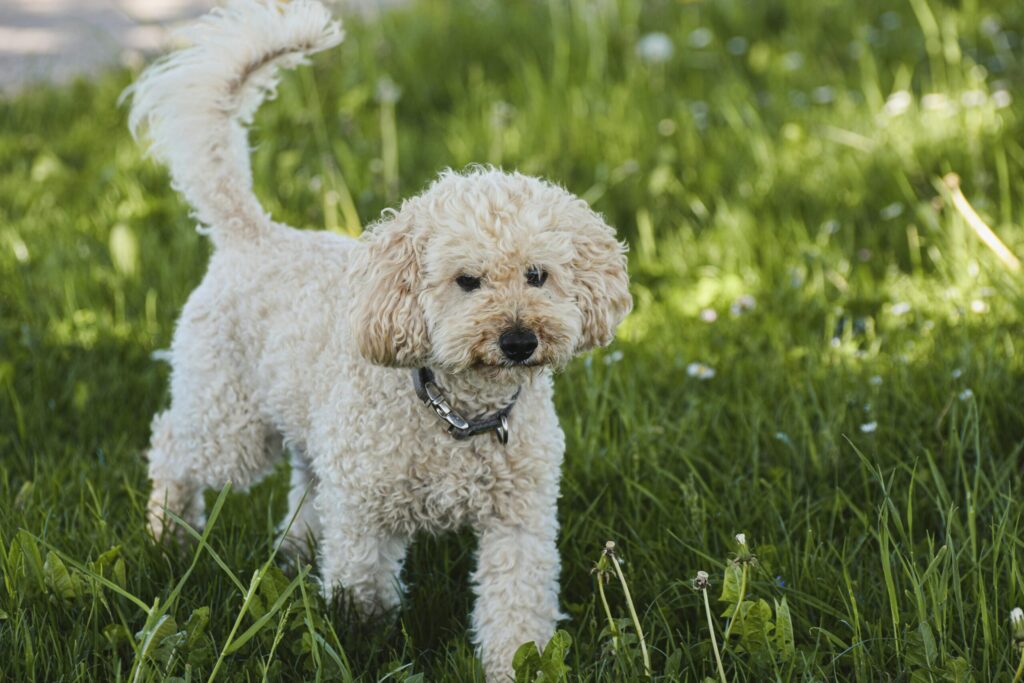
Frustration hook: “I can’t move without my poodle”
You’re not imagining it. Some poodles act like your personal assistant, escorting you to the kitchen, the loo, and back again, then staring like you’ve missed an important meeting.
That can be cute. It can also be exhausting.
Are poodles affectionate, or anxious?
“Are poodles affectionate?” Usually, yes. “Are poodles clingy?” Also often yes, but clinginess is not one thing.
It’s typically one of these:
- Affection habit: they’ve learned closeness equals good stuff.
- FOMO: they think something interesting might happen without them.
- Anxiety: they panic when access to you is removed.
A quick self-check: if your poodle can relax on a bed across the room while you work, you’ve mostly got affection and habit. If they can’t eat, can’t settle, and can’t stop scanning for you, you’re closer to anxiety territory.
Proximity vs. Pestering: The “Room-by-Room” Strategy
Poodles are famous “shadow dogs,” but there is a nuanced difference between a dog that loves you and a dog that is “patrolling” you. I’ve noticed that many Poodles don’t actually want to be petted 24/7. They want “strategic proximity.” They want to be in the same room, likely touching your foot, but they might growl or move away if you try to initiate a heavy cuddle session while they’re resting.
This is the “Poodle Paradox”: they are clingy but value their personal bubble. If you ignore this, you end up with a dog that follows you to the bathroom but snaps if you reach for them on the sofa.
The Fix: Give them “passive affection” zones. Use a raised cot or a specific rug in every room you frequent. This satisfies their need to “plug in” to your location without the social pressure of constant interaction. This simple adjustment usually cuts demand-barking by half within a week because the dog finally understands where they are “supposed” to be.
How to build independence without being cold
Independence training doesn’t mean ignoring your dog. It means teaching safety in small doses.
Try this:
- Create a “parking spot” (mat or bed) that pays well.
- Do micro-separations all day: step behind a door for 3 seconds, return, reward calm.
- Feed some meals in a crate or behind a baby gate, so barriers predict good things.
- Practice leaving the room without making it emotional (no big goodbye speeches).
And yes, the irony: the more predictable you are, the less clingy many poodles become.
Barking: why it happens and how to reduce it
Alert barking vs demand barking vs separation barking
Most poodle behavior around barking gets easier when you name the type:
- Alert barking: “Something changed.” Door sounds, hallway noises, passing people.
- Demand barking: “Make the thing happen.” Throw the toy. Fill the bowl. Look at me.
- Separation barking: “You left, and I can’t cope.”
Different cause, different fix.
Toy and Mini barking: why smaller poodles often get labeled “yappy”
Questions like “do toy poodles bark a lot” or “do miniature poodles bark a lot” usually come from people living close to other humans. A small poodle hears more, sees more, and often gets more reinforcement for noise (even a shout is attention).
Also, many small dogs don’t get enough decompression time outside. Not exercise. Decompression. Slow sniffing, wandering, and feeling safe.
A practical 10-minute daily anti-bark routine (micro-optimization)
Now, something most guides miss: you can make barking training easier by “pre-paying” calm before the trigger happens.
Here’s a tight daily routine that doesn’t take over your life:
- Two minutes of mat reps: reward for stepping on, then for lying down.
- Two minutes of “thank you” cue: when your poodle hears a small noise and looks at you, mark and reward. You’re building a check-in reflex.
- Two minutes of treat scatter: toss 6 to 10 tiny treats on the floor. Sniffing lowers arousal.
- Two minutes of door practice: touch the door handle, reward calm. Open one inch, reward calm. Close. Repeat.
- Two minutes of “quiet reset”: if barking starts, calmly guide to the mat, reward the first second of silence, then release.
Micro-optimization that helps in flats: pick one daily “bark window” (mail time, school run, whatever) and run white noise 10 minutes before it starts. You’re not fixing training with sound. You’re lowering the difficulty so training can work.
Aggression: are poodles aggressive dogs?
What “aggression” actually includes (and what it’s often confused with)
When people ask “are poodles aggressive?”, they’re usually describing one of these:
- Reactivity on lead (barking, lunging, big feelings).
- Resource guarding (over toys, food, stolen socks).
- Handling sensitivity (growling when picked up, groomed, or hugged).
- Fear behavior (snapping to make something go away).
Aggression is a behavior, not a personality label. And it’s often a strategy a dog uses when other strategies didn’t work.
Common triggers: fear, guarding, over-handling, pain
If you’re worried about poodle aggressive behavior, focus on triggers before you focus on “dominance” theories.
Common real-world causes:
- Fear and lack of early positive exposure.
- Too much rough handling, especially in Toys.
- Grooming stress (mats pulling, uncomfortable restraint).
- Pain (teeth, ears, hips, skin itch, GI discomfort).
- Repeated forced interactions with kids or visitors.
If you see a sudden behavior shift, treat “health check” as part of training. Not optional.
When to get professional help (clear red flags)
Don’t wait it out if you’re seeing:
- Bites that break skin.
- Stiff freezing, hard staring, and guarding around food or stolen items.
- Escalation over time, not improvement.
- Aggression toward family members, not just strangers.
- Signs of panic when left alone (self-injury, destruction focused on exits).
Look for a qualified, reward-based behavior professional. The goal is safety plus skill-building, not suppression.
Are poodles good family dogs?
Many are, but “good family dogs” isn’t a breed stamp. It’s a match between dog needs and family routines.
Kids, visitors, and the “polite greeter” plan
Poodles can love family life, but they often dislike chaos without structure.
A simple plan that prevents a lot of drama:
- Teach “go to mat” before you teach “say hello.”
- Reward four paws on the floor. Every time.
- Give kids a script: call the dog to them, offer a treat on an open palm, no hugging, no face-to-face hovering.
- Use baby gates during peak chaos so your poodle can opt out.
The best family dog is the dog who gets to take breaks.
Multi-pet homes and social skills
Poodles often do well with other dogs when they’re properly socialized, but watch for:
- Over-arousal play (they can be bouncy and mouthy).
- Toy guarding (especially with high-value chews).
- “Referee mode” barking when other pets move around.
Teach turn-taking games and separate high-value items. Management is not failure, it’s smart.
The grooming factor (behavioral impact most people miss)
Grooming is a huge part of poodle behaviour problems, in disguise. If brushing hurts or restraint feels scary, your dog won’t just “get used to it.” They’ll learn to resist.
Make grooming a training project:
- Tiny sessions, lots of rewards.
- Teach chin-rests and paw-presents.
- Stop before your dog is done.
A calm grooming routine often improves overall behavior because it reduces daily stress.
The “Matting-to-Mood” Pipeline
We talk about grooming as a chore, but we rarely talk about it as a temperament trigger. Poodles have a specific “hidden friction” called tactile irritability. Because their hair doesn’t shed and continues to grow into the skin, even minor matting creates a constant, low-grade tugging on the nerves. In my observations, a Poodle who is suddenly “snappy” or “sensitive” to being touched on the ears or paws is often just dealing with physical discomfort from their coat.
This is especially true during the “coat change” phase around 8 to 14 months, where the puppy fluff tangles into the adult coat overnight. I’ve seen countless owners misdiagnose this as a sudden onset of aggression.
Pro tip: If you can’t slide a metal comb through the hair all the way to the skin, your dog is likely in a state of sensory overload. Before you hire a behaviorist for “sudden snapping,” book a “sanitary shave” or a short clip. You’ll often find the “aggression” vanishes the moment the skin can breathe. My recommendation? Keep them in a “utility clip” (short all over) until their adult temperament fully stabilizes. It removes a massive layer of daily irritation for both of you.
FAQ
Are poodles aggressive?
Most poodles aren’t walking around looking for trouble, but any dog can show aggression if they’re scared, guarding something, or pushed past their comfort zone. If you’re seeing growling or snapping, treat it as communication and change the situation, then train a safer alternative.
Are standard poodles aggressive?
Standard Poodles are often social and people-focused, but they can still become reactive or defensive if under-socialized, mishandled, or in pain. The big win with Standards is that they usually have the athleticism and attention span for structured training that makes problems easier to resolve.
Are toy poodles aggressive?
Toy Poodles can look “snappy” because they’re small and the world is intense, lots of looming hands and surprise handling. Focus on predictable handling, consent-based grooming, and teaching kids and visitors how to interact calmly.
Are miniature poodles aggressive?
Miniatures aren’t inherently aggressive, but they can become vocal or reactive if they practice those habits daily (like barking at hallway sounds). With minis, a little calm-training plus enrichment usually goes a long way.
Are poodles high energy?
They can be. Many poodles are energetic in the sense that they’re ready for engagement and they get bored fast. The fix is a mix of physical outlets, mental work, and deliberate “switch-off” training, not endless running.
Do toy poodles bark a lot?
Toy Poodles can be barky, especially in busy homes or flats where they hear everything. Identify the barking type (alert, demand, separation), then train a replacement behavior like mat settling, check-ins, or a quiet cue.
Do miniature poodles bark a lot?
Miniature Poodles can bark a lot if they’ve learned barking gets results, attention, play, or even you coming to investigate. Reduce rehearsal (block window views, use white noise at peak times) and pay heavily for calm.
Are poodles clingy, and can you fix it?
Many are naturally people-oriented, but you can absolutely reduce clingy behavior. Teach independence in tiny reps, reward relaxation away from you, and avoid turning departures into an emotional event.
Are poodles good family dogs?
Often, yes, if the family likes interaction and can commit to training, grooming, and daily mental stimulation. The best match is a family that builds routines: calm greetings, predictable rest time, and clear boundaries.
Final Thoughts
Poodle Temperament is best understood as a blend of brains, sensitivity, and social attachment. If you meet those needs on purpose, you usually get the fun version of the breed: engaged, affectionate, and brilliant company.
Three action steps you can do this week:
- Teach a mat settle and use it daily after walks and before meals.
- Pick one behavior to reduce (barking, clinginess, jumping) and track triggers for seven days before changing your plan.
- Make grooming cooperative: short sessions, high rewards, stop early.
If you want a poodle who feels easy to live with, don’t chase perfection. Build skills, lower stress, and reward calm like it’s a trick.
